A hotel phone system that integrates with the stack you already run
A hotel PBX isn't a business phone system with extra features bolted on. It has to speak to the property management system, track room status, automate wake-up calls with retry logic, post minibar charges, and route emergency calls to the front desk and 911 simultaneously. IntelliVoice Hotel PBX does all of that natively — in the cloud, with your existing IP phones or new ones.
Properties from 20-room boutique B&Bs to 400-room resorts run on the same platform, scaled to each deployment.
Talks to the property management system your front desk already uses
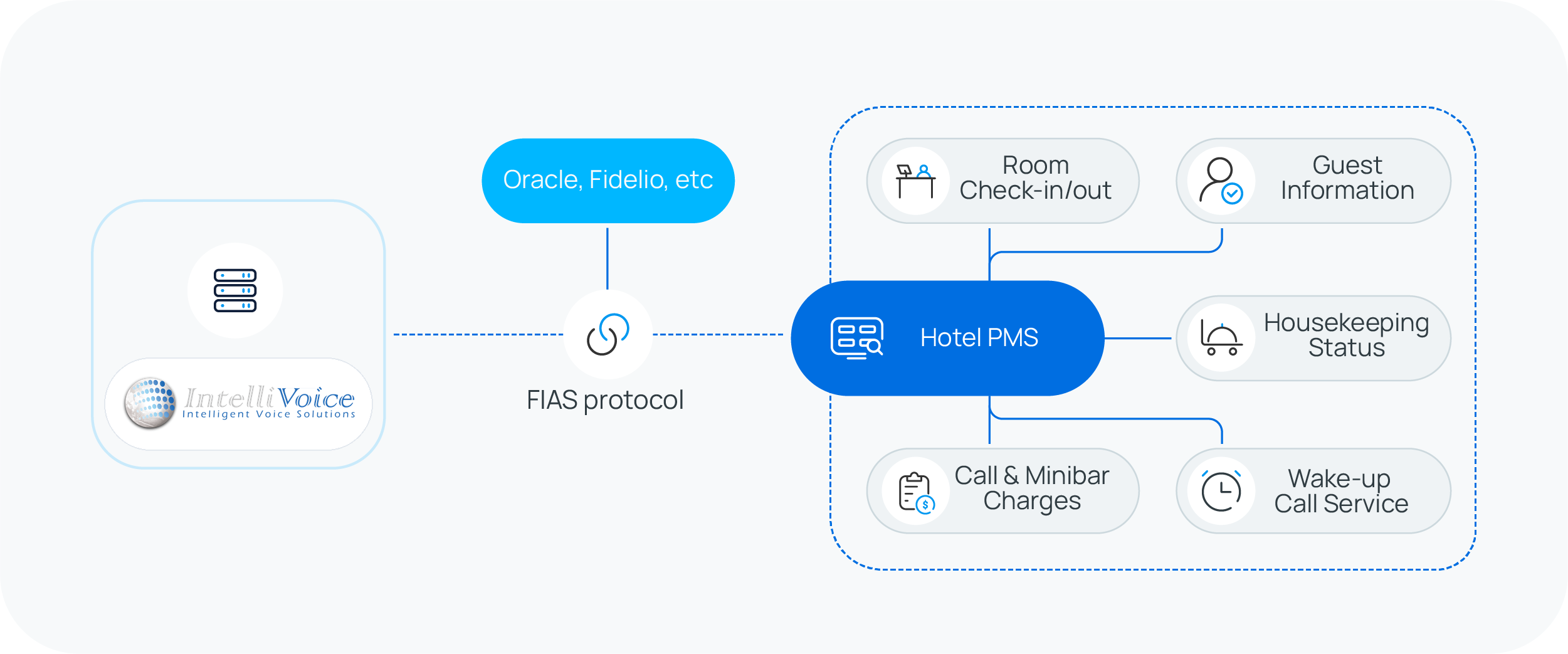
Native integration over FIAS (Fidelio), SIP-PMS, and HTNG standards. If your PMS supports one of these, we connect — no custom development fees for the platforms below.
Opera / OPERA Cloud
Full bidirectional FIAS integration. Check-in, check-out, wake-up, minibar, housekeeping, and message waiting light all synced.
Opera PMS integration →Marriott Lightspeed
Certified Lightspeed PBX interface for Marriott-flagged properties. Meets Marriott brand standards for voice.
Lightspeed PBX interface →Mews
Modern REST/HTNG integration for cloud-native boutique and lifestyle properties.
Mews PMS integration →RMS Cloud
Popular for resorts and extended-stay. Full check-in/out, wake-up, and charge posting.
Cloudbeds
For independent and mid-scale hotels. SIP-PMS profile keeps the front desk console in sync.
Custom PMS
Property running a proprietary or legacy PMS? We've integrated with 40+ systems. Scoping call is free.
What a hotel PBX interface actually is
When a hotel IT team asks about the “hotel PBX interface,” they mean one thing: the live data link between the phone system and the property management system. Not a nightly export — a persistent, bidirectional session in which the PMS tells the PBX what is happening to every room, and the PBX reports what is happening on every phone.
What flows across the link
The phone leaves emergency-only restriction at check-in and returns to it at check-out.
Name and language land on the room extension, driving internal caller ID and prompt language.
A housekeeper dials a status code from the room phone; the PMS housekeeping board updates live.
Set at the room phone, console, or in the PMS. Results — answered, no answer — report back.
Staff dial a posting code plus item and quantity, and the amount lands on the guest folio.
Each call generates a CDR, gets rated, and posts with room, number, duration, and charge.
MWI lamp and stutter tone follow messages. DND set in the PMS intercepts calls to the room.
Name, class of service, voicemail, and pending wake-ups follow the guest to the new room.
How the PMS link is actually wired
The dominant hotel PBX interface protocol is FIAS — the Fidelio Interface Application Specification, created for Fidelio and carried into OPERA by Oracle Hospitality. FIAS is a plain-ASCII, record-based protocol: each message is a short typed record covering link control, guest records, room status, wake-up requests, postings, and message-waiting changes. Link-alive heartbeats run both ways, so a dead session raises an alarm instead of silently drifting out of sync.
Historically FIAS ran over an RS-232 serial cable between the PBX and the PMS interface server in the same MDF — hence the null-modem cable nobody at a legacy property wants to touch. Modern deployments carry the same record stream over a TCP/IP socket; where one end is still serial-only, a serial-to-IP terminal server bridges it.
Cloud-era PMS platforms moved past FIAS: OPERA Cloud exposes OHIP REST APIs, the HTNG specifications define web-service equivalents, and Mews publishes its own REST API. Either way a layer of middleware sits between the two worlds — a connector that holds the persistent PMS session, normalizes records into the PBX’s event model, queues postings so a brief PMS restart doesn’t lose a charge, and logs every record. IntelliVoice runs that connector as part of the service, on-property or cloud-to-cloud.
Worth budgeting for: most PMS vendors license the interface itself — Opera treats the PBX interface as a licensed component. That license comes from the PMS vendor, not IntelliVoice, and missing it is the most common cause of a delayed go-live.
Already know your PMS? Go straight to the interface detail: Oracle OPERA / OPERA Cloud, Marriott Lightspeed, or Mews.
Property management systems we interface with
If your PMS speaks FIAS, OHIP, HTNG, or a documented REST API, the IntelliVoice hotel PBX interface connects to it. These are the platforms we see most often.
Running something proprietary or end-of-life? Send us the PMS vendor’s interface specification and we’ll tell you on the scoping call whether it maps cleanly.
What changes when the hotel PBX moves to the cloud
A hosted hotel PBX moves the parts that break and expire — call control, voicemail, the auto-attendant, the wake-up scheduler, call accounting and rating, the PMS connector, and the trunks — into the FusionUC cloud platform. Analog and digital trunks give way to SIP trunking, which is what makes multi-property number management practical.
What does not move is the physical plant, and that is the part most buyers get wrong. Guest-room phones, their station cabling, the MDF and IDF closets, and the elevator and house phones stay where they are. The cloud PBX reaches them through FXS gateways that terminate the existing 25-pair cabling and present each room as a SIP endpoint — so for most properties there is no re-cabling and no new handsets.
Survivability is the fair question to ask of any hosted hotel PBX, and the answer is a hybrid edge: the on-property gateway keeps room-to-room dialing, front-desk calling, and 911 alive if the WAN drops, while the circuit fails over to LTE or Starlink in under a minute. For management companies the larger win is multi-property — one portal, a shared dial plan, per-property emergency location data, and consolidated billing.
Your hotel phones stay up when the internet doesn't
Hotels can't afford a phone outage — guests can't reach the front desk, 911 calls don't route, and room charges stop posting. IntelliVoice Hotel PBX deployments include automatic internet failover by default.
- Primary fiber + LTE secondary — sub-30-second cutover via SD-WAN edge router
- Starlink failover — ideal for coastal and storm-exposed properties
- Carrier-level inbound failover — the PSTN can reroute to a second circuit or LTE number if both primary paths fail
- Geographic cloud redundancy — FusionUC runs in multiple data centers; a single-region outage does not take down calls
This is the same failover pattern we deploy for Florida hotels facing hurricane season — proven under actual outages, not just in the datasheet.
Features your guests (and front desk) actually use
Automated Wake-Up Calls
Guests schedule from the room phone, front desk, or in-room tablet. System retries on no-answer and flags the front desk if three retries fail.
Guest Voicemail
Message waiting light on the room phone. Voicemail auto-resets at check-out so the next guest starts clean. Optional email copy to the guest's profile on file.
Multi-Language IVR
Front-desk auto-attendant and voice prompts in English, Spanish, French, and Portuguese. Language preference pulled from the PMS guest record when available.
Housekeeping Status
Housekeeping staff enter room status codes from the room phone — clean, inspected, out-of-order, maintenance — and the PMS updates in real time.
AI Voice Reservation Agent
Optional Voce AI voice agent for after-hours reservation intake and overflow. Books directly into the PMS; escalates to a human when needed.
Emergency & Safety
911 calls route with per-room address and simultaneously alert the front desk console so staff can respond on-property.
From 20-room B&Bs to 400-room resorts
A cloud architecture is actually a better fit for smaller properties than a legacy on-premise hotel PBX — no server closet, no battery backup to maintain, no expensive upgrade cycle. And for larger properties, it scales without buying a bigger box.
Why the interface matters to a flagged property
An independent hotel can choose its phone system freely. A franchised property under Marriott, Hilton, IHG, Hyatt, Choice, Wyndham, or Best Western cannot — each brand publishes a standards manual, and voice has line items in it. Specifics differ by brand and tier, but the themes come back to the interface: a guest-room telephone meeting brand spec (message-waiting lamp, one-touch keys to the operator and guest services, ADA volume control and hearing-aid compatibility), a working PMS interface so phones activate and restrict with guest status, accurate call accounting and charge posting, and emergency call handling with on-site notification.
That matters at audit time, because an inspector does not read a datasheet. They check a guest in and pick up the room phone, set a wake-up call, and dial 911 to confirm the front desk is notified — exactly the functions that live on the PMS link. IntelliVoice runs a documented room-by-room test matrix before cutover and hands the property the results, scoped against the standards manual in force on your renewal date.
Cutting over a live, occupied hotel
A hotel never closes for a phone upgrade. Every migration assumes an occupied property, a front desk that cannot stop checking guests in, and a hard requirement that 911 works from every room throughout the cutover.
1. Discovery
Room count and numbering, station cabling and MDF/IDF layout, existing PBX model, PMS platform and version, whether the PMS interface license exists, trunk and DID inventory, and every non-guest line: elevator, pool, house, fax, paging, alarm.
2. Parallel build & interface test
Gateways are staged alongside the existing PBX, not in place of it, and the PMS interface is built against a training instance where the vendor offers one — so check-in, wake-up, posting, and MWI are proven before any guest is affected.
3. Reuse the room phones
Existing analog guest-room sets and their 25-pair cabling are normally retained on FXS gateways. We verify lamp voltage and stutter dial tone on the actual handsets first, since old sets occasionally need replacing to light MWI.
4. Porting
Main numbers, DID blocks, and the reservations line port to IntelliVoice SIP trunks, with a pre-cutover forward so inbound calls already land on the new platform before the port completes.
5. Elevator & emergency phones
Elevator, area-of-refuge, and pool phones need a path that survives a power or WAN outage — code requires two-way communication from an elevator car. These stay on a battery-backed analog loop or protected FXS port, tested car by car.
6. Overnight cutover
We cut during the lowest-occupancy window, block by block, with the legacy PBX left powered as a rollback path until the morning check-out run proves the interface. Staff are trained before the shift change, not after.
Kari’s Law and guest-room 911
Hotels are the reason Kari’s Law exists. It requires that a multi-line telephone system let a caller reach 911 by dialing 911 directly — no 9, no access code — and that it notify an on-site point of contact such as the front desk when a 911 call is placed, so staff can meet responders and get them to the right room. RAY BAUM’S Act adds the second half: the call must carry a dispatchable location — street address plus room number, floor, and wing. One address for a 300-room resort is not a dispatchable location.
On the IntelliVoice hotel PBX every guest room gets its own location record rather than inheriting one property-wide address, direct 911 dialing is on by default and cannot be configured away, and the front-desk console plus a configurable list of mobiles and email addresses are alerted the moment a room dials 911 — with room and timestamp. Those alerts survive LTE or Starlink failover, and we test 911 from sample rooms on every floor at cutover sign-off.
Hotel PBX: common questions
What is a hotel PBX system?
A hotel PBX is a phone system purpose-built for hospitality. Beyond normal calling, it integrates with the property management system (PMS), tracks room occupancy status, automates wake-up calls, posts minibar and phone charges back to the guest folio, and handles housekeeping status codes. Modern cloud hotel PBX systems replace legacy hardware (Mitel, NEC, Hitachi, Nortel) with software in the cloud — fewer on-site boxes, more features, lower total cost.
What is a hotel PBX interface?
A hotel PBX interface is the live, bidirectional data link between the phone system and the property management system. The PMS sends check-in, check-out, room moves, guest name and language, do-not-disturb and message-waiting changes; the PBX sends back wake-up results, housekeeping status codes, minibar postings, and rated call charges for the folio. The usual protocol is FIAS (Fidelio Interface Application Specification), carried over serial on legacy systems and over TCP/IP today; cloud PMS platforms use REST interfaces such as Oracle’s OHIP or HTNG instead.
How does a cloud hotel PBX integrate with PMS platforms like Opera or Marriott Lightspeed?
Via industry-standard protocols — FIAS (Fidelio), SIP-PMS, and HTNG. IntelliVoice is certified with Opera, Opera Cloud, Marriott Lightspeed, Mews, RMS Cloud, Cloudbeds, and Hotel Effectiveness. Check-in automatically opens outbound calling and resets voicemail; check-out closes the line and archives messages. Wake-up, charges, housekeeping status, and message-waiting lights all sync bidirectionally.
Does a hosted hotel PBX work with Opera PMS?
Yes. A hosted hotel PBX connects to Oracle OPERA over the same FIAS interface an on-premise PBX uses — a TCP session to the PMS interface server — so it makes no difference that call control lives in the cloud. For OPERA Cloud, IntelliVoice connects over OHIP/HTNG REST instead, and an on-property connector queues postings so a brief interruption does not lose a charge. One caveat: Oracle licenses the PBX interface on the PMS side, and that license must be in place before go-live. See our Opera PMS integration page for detail.
Can a cloud PBX post minibar and call charges to the guest folio?
Yes, and both post in real time rather than in a nightly batch. For call charges the PBX writes a CDR, the call-accounting engine rates it, and a posting record goes to the PMS with the room number, number dialed, duration, and amount. For minibar, staff dial a posting code plus item and quantity from the room phone. Because posting happens as it occurs, nothing is lost when a guest uses express checkout.
What is the difference between a hosted hotel PBX and an on-premise hotel PBX?
A hosted hotel PBX moves call control, voicemail, the auto-attendant, the wake-up engine, call accounting, the PMS connector, and the trunks into the cloud. The physical plant stays: guest-room phones, station cabling, MDF and IDF closets, FXS gateways, paging, and elevator phones. What disappears is the PBX cabinet, the battery plant, the maintenance contract, and the refresh cycle. A hybrid edge gateway keeps room-to-room dialing, front-desk calling, and 911 working if the internet drops.
How much does a cloud hotel phone system cost?
Pricing is per room, typically $3–$8/room/month depending on integration depth, feature set, and call volume, with volume breaks above 50 rooms. That includes the PBX, unlimited US/Canada calling, PMS integration, and 24/7 support. IP phones and front-desk consoles are quoted separately. Request a custom quote for your property.
Can a cloud hotel PBX handle a small 50-room property?
Yes — a 50-room hotel is actually a better fit for cloud than for on-premise hardware. No server to rack, no battery backup to maintain, no 7–10 year upgrade cycle. Deployment is typically 1–2 days: IP phones in each room, a front-desk console, edge router with LTE or Starlink backup, PMS integration tested. Monthly cost is predictable; upfront cost is a fraction of a hardware PBX replacement.
What happens to the phones if the internet goes down?
Every IntelliVoice Hotel PBX deployment includes automatic internet failover — typically LTE or Starlink as a secondary path. When the primary circuit drops, the edge router switches traffic in under 30 seconds. Inbound calls reroute via carrier-level failover, so guests can still reach the property and 911 still works. We've proven this pattern at Florida properties during hurricane season — phones stay up when fiber doesn't.
Does a hosted hotel PBX satisfy Kari’s Law for guest rooms?
Kari’s Law requires that a guest be able to dial 911 directly with no prefix, and that the system notify an on-site point of contact — typically the front desk — when a 911 call is placed. RAY BAUM’S Act additionally requires a dispatchable location, so the room number and floor travel with the call rather than just the street address. On the IntelliVoice hotel PBX each guest room carries its own location record, direct 911 dialing cannot be disabled, and notifications keep working during LTE or Starlink failover.
Can the system do wake-up calls and multi-language greetings?
Yes. Wake-up calls are scheduled from the front desk, the PMS, or the room phone itself — the system retries on no-answer and alerts the front desk if repeated retries fail. Voicemail greetings and auto-attendants run in multiple languages simultaneously (English, Spanish, French, Portuguese by default); when the PMS tags a guest's language preference, the system picks the right prompt automatically.
Can you replace our existing Mitel/NEC/Hitachi hotel PBX?
Yes — replacement of legacy hotel PBX hardware is the majority of what we do. In most cases we keep your existing SIP-compatible room phones and replace only the PBX and front-desk console. We handle the PMS re-integration, number porting, and cutover, typically with zero guest-facing downtime.
More for hospitality operators
Book a hotel PBX demo
30-minute walk-through of the platform with a PMS-integration scoping session. Bring your current call flows and PMS details.
Book a DemoAlready evaluating? Skip the demo and get a scoped quote:
🏨 Take the Migration Survey →