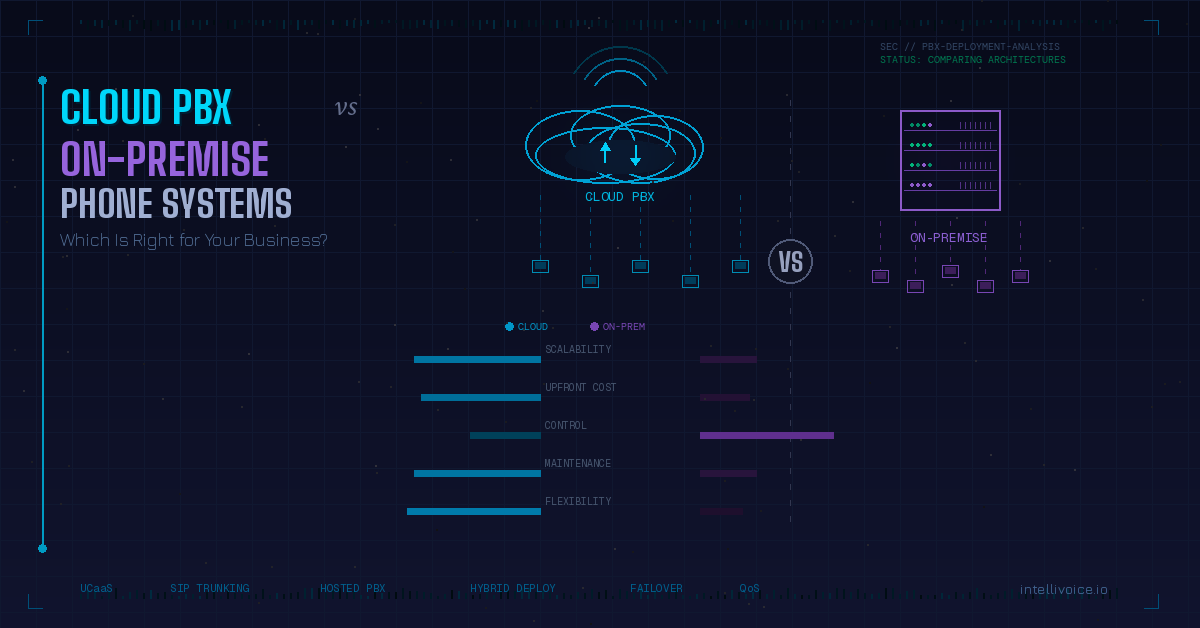
Cloud PBX vs On-Premise Phone Systems: Which Is Right for Your Business?
The debate between cloud and on-premise phone systems is effectively over for most businesses. But the right choice still depends on your specific requirements. Here's everything you need to know to make the right decision.
Quick answer
Cloud PBX hosts your business phone system in a provider's data centers and is billed per user per month ($25–$45 typical); on-premise PBX runs on hardware you buy and maintain in your office. Cloud wins on cost (no capex, predictable opex), ease of remote work, automatic updates, and 99.99% uptime SLAs backed by geographic redundancy. On-premise still makes sense when you have strict sovereignty requirements, a large existing PBX investment mid-depreciation, or no reliable internet connectivity. For most businesses with fewer than 500 users in 2026, cloud PBX is the correct choice.
If you're evaluating business phone systems in 2026, you've probably heard that "cloud is the future." And for most organizations, that's true. But making the right choice requires understanding exactly what each option offers and where it falls short.
This guide breaks down the real differences between cloud PBX and on-premise phone systems, covering costs, features, reliability, and the scenarios where each makes sense.
Understanding the Basics
What Is Cloud PBX?
A cloud PBX (Private Branch Exchange) is a business phone system hosted in data centers and delivered over the internet. Your provider manages all the hardware and software, while you pay a monthly subscription per user.
With cloud PBX, your desk phones, mobile apps, and softphones connect to your provider's infrastructure. Calls route through the cloud, and features like voicemail, auto attendant, and call recording are all handled remotely.
What Is On-Premise PBX?
An on-premise PBX is a phone system that lives in your building. You own the hardware, typically installed in a server room or telecom closet, and your IT team (or a vendor) manages it.
Traditional on-premise systems connected to analog phone lines. Modern on-premise systems often use SIP trunking for connectivity but still keep the core PBX hardware in-house.
The Real Cost Comparison
Cost is usually the first question. Here's an honest breakdown:
| Cost Factor | Cloud PBX | On-Premise |
|---|---|---|
| Initial Investment | $0-500 (phones only) | $15,000-50,000+ |
| Monthly Cost (50 users) | $1,000-2,500/month | $200-500/month (SIP trunks + maintenance) |
| 5-Year Total | $60,000-150,000 | $27,000-80,000 |
| Hardware Refresh | Provider handles it | Every 7-10 years ($15,000+) |
| IT Staff Time | Minimal | Significant |
At first glance, on-premise looks cheaper over time. But this comparison misses several factors:
- Opportunity cost of capital: That $30,000 upfront could be invested elsewhere
- IT labor costs: On-premise systems need hands-on management
- Upgrade costs: New features often require expensive hardware or software upgrades
- Scaling costs: Adding capacity means buying more equipment
For most businesses under 200 employees, cloud PBX costs less when you factor in total cost of ownership.
Feature Comparison
Modern cloud PBX systems have caught up to—and often exceed—on-premise capabilities:
| Feature | Cloud PBX | On-Premise |
|---|---|---|
| Auto Attendant | Included | Included |
| Voicemail to Email | Included | Usually included |
| Mobile Apps | Included | Often extra cost |
| Video Conferencing | Usually included | Usually separate |
| Team Messaging | Usually included | Rarely included |
| CRM Integration | Easy, often built-in | Custom development |
| AI Features | Rapidly advancing | Limited |
| Call Recording | Included or low cost | Often requires separate server |
The biggest advantage cloud PBX has today is rate of innovation. Cloud providers can roll out new features monthly. On-premise systems often require expensive upgrades to access new capabilities.
Reliability: The Biggest Concern
Business owners often worry about cloud reliability. "What if the internet goes down?" is the most common objection.
Here's the reality:
Cloud PBX Reliability
- Top providers offer 99.999% uptime (about 5 minutes of downtime per year)
- Geo-redundant data centers mean no single point of failure
- Automatic failover to mobile apps if office internet fails
- Your internet connection is the weak link, not the phone system
On-Premise Reliability
- System uptime depends on your hardware and power
- Single point of failure unless you invest in redundancy
- Power outages take down phones (without UPS)
- Hardware failures require on-site repair
For most businesses, a properly implemented cloud PBX with backup internet is more reliable than on-premise. The cloud provider has better redundancy than most businesses can afford to build themselves.
When On-Premise Still Makes Sense
Despite cloud's advantages, on-premise is still the right choice in specific scenarios:
1. Unreliable Internet Connectivity
If your location has truly poor internet options (rural areas, older buildings), on-premise with analog lines may be more reliable. However, this is increasingly rare with fixed wireless and satellite options improving.
2. Strict Data Sovereignty Requirements
Some industries require that all communications data stay on-site. Government contractors, certain financial institutions, and some healthcare organizations may have this requirement.
3. Existing Investment with Life Remaining
If you installed a modern on-premise system in the last 2-3 years, there's no rush to replace it. Plan your cloud migration for when the system reaches end-of-life.
4. Very Large Organizations (500+ Users)
Enterprise organizations with dedicated telecom staff may find on-premise (or hybrid) more cost-effective. But even enterprises are increasingly moving to cloud.
The Hybrid Option
Some businesses choose a hybrid approach:
- Cloud PBX for most employees
- On-premise equipment for specific requirements (like analog fax lines or security systems)
- SIP trunking connecting both environments
This gives you cloud benefits while accommodating legacy needs. A good provider can help design a hybrid solution that makes sense for your situation.
Making the Decision
For most businesses evaluating phone systems in 2026, the answer is cloud PBX. The math works out better, the features are superior, and reliability concerns are largely outdated.
Choose cloud PBX if you:
- Have 5-500 employees
- Want predictable monthly costs
- Need remote work capabilities
- Want modern features without extra cost
- Don't want to manage telecom infrastructure
Consider on-premise if you:
- Have regulatory requirements for on-site data
- Have truly unreliable internet with no alternatives
- Have a recent on-premise investment you need to amortize
- Have 500+ users with dedicated telecom staff
Questions to Ask Any Provider
Whether you choose cloud or on-premise, ask these questions:
- What's your uptime SLA, and what's the financial penalty if you miss it?
- Where are your data centers located? What's your redundancy model?
- What's included in the base price vs. add-on costs?
- How do you handle number porting and implementation?
- What does your support model look like? Response time guarantees?
- What's the contract length and termination clause?
- How do you handle compliance requirements (HIPAA, PCI, etc.)?
Ready to Compare Options?
Our team can help you evaluate whether cloud PBX is right for your business. Get a personalized comparison based on your specific requirements.
Book a ConsultationThe Bottom Line
The cloud vs. on-premise debate is mostly settled. Cloud PBX wins for the vast majority of businesses on cost, features, reliability, and flexibility.
The remaining question isn't whether to go cloud, but which cloud provider to choose. Look for providers with proven uptime, transparent pricing, and experience in your industry.
If you're still on an aging on-premise system, now is the time to plan your migration. The longer you wait, the more you're paying for maintenance on a depreciating asset while missing out on modern capabilities.